
TNUoS Charge increases from April 2026: What you need to know
Learn about significant changes to Transmission Network Use of System (TNUoS) third party charges and how this will affect your business electricity service from 1st April 2026.

As the UK upgrades its electricity network and works toward net zero, rising Transmission Network Use of System (TNUoS) charges from April 2026 will fund critical grid upgrades, supporting a cleaner, more resilient system capable of delivering more renewable and low-carbon electricity.
From 1st April 2026, Transmission Network Use of System (TNUoS) pass-through charges are set to rise sharply, with further increases expected through to 2030/31. These charges are set by the National Energy System Operator (NESO) and regulated by Ofgem.
What are TNUoS charges?
TNUoS charges cover the cost of maintaining and upgrading Great Britain’s high-voltage transmission network - the pylons, cables, and substations that carry electricity from power stations to businesses. They form a key part of the non-commodity portion of electricity bills, representing network-mandated costs that suppliers typically pass through to business customers.
Why are they increasing?
The upcoming rise in TNUoS charges is mainly due to the start of the new price control period, during which Transmission Owners will operate under new revenue allowances and investment frameworks. The primary driver behind these changes is network reinforcement - major grid upgrades needed to connect and transport growing volumes of renewable generation across the UK.
The rise in TNUoS charges is mainly because of a new set of rules for how transmission companies fund and invest in the electricity network. These increase is driven by:
- Upgrading the network: The grid needs reinforcement to carry growing amounts of renewable energy from remote areas to where it’s needed.
- Supporting clean energy: Expanding the network helps connect more low-carbon projects, which is essential for the UK’s net zero targets.
- Updated forecasts: NESO has refined its calculations, including transport models and location-based charges, which has pushed predicted costs higher.
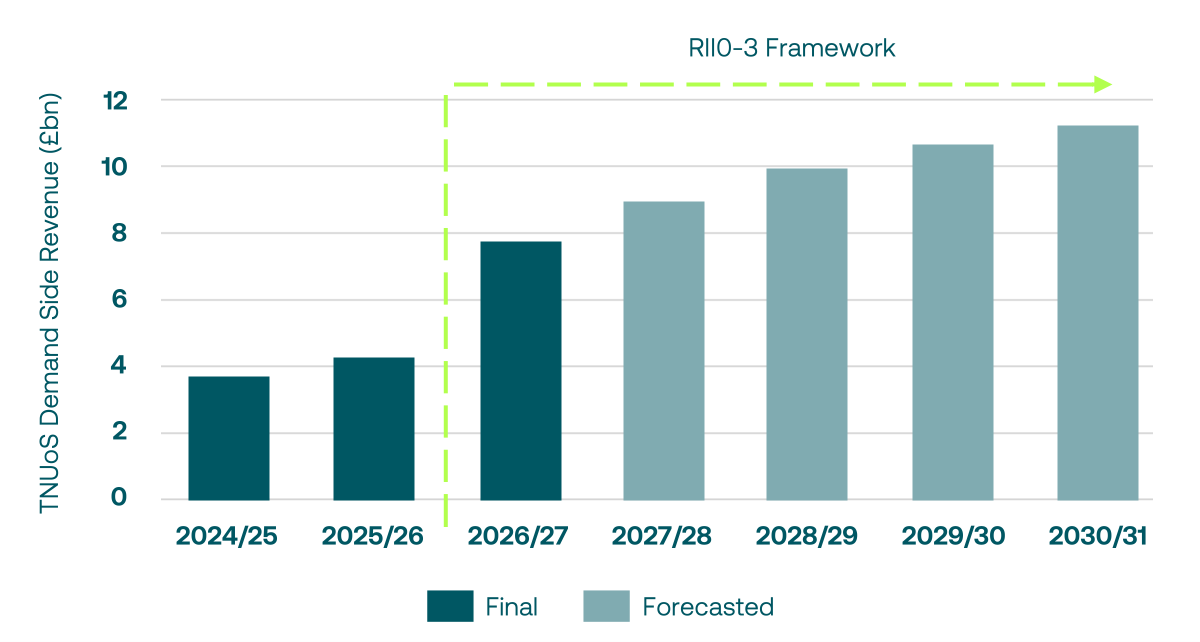
According to the latest tariffs from NESO, demand-side residual revenue will reach £7.52 billion in 2026/27, almost double the 2025/26 level and £3.86 billion higher than earlier forecasts. Further increases are also forecasted through to 2030-31 through the RIIO-3 framework. RIIO-3 (Revenue = Incentives + Innovation + Outputs) determines the revenue allowed for network companies.
What this means for your business
TNUoS charges relate to the non-commodity part of your electricity service. These network-mandated costs sit entirely outside the control of both suppliers and brokers, and they are passed through directly to customers.
Historically, we have sought to absorb smaller annual fluctuations in these costs to help maintain price certainty for our customers. However, due to the unprecedented size of the TNUoS increase, we have taken the difficult decision to pass this through.
We're in the process of writing to customers who are directly affected by the change, to confirm exactly what the charges are and how this will impact their monthly bills. The adjustment varies depending on your site, grid connection type, and electricity capacity.
It's important to note that neither any broker or third‑party intermediary who may have introduced you to SmartestEnergy Business, nor SmartestEnergy Business itself, could have reasonably anticipated the scale or timing of these increases.
If your business has been impacted, we are committed to supporting you through the change. We appreciate that any cost increase is unwelcome. Our aim is to provide full transparency around these regulated network charges and support your business through this change. As the wider energy market evolves, we will continue to keep you informed and provide clear updates on any further developments that may affect your service.
Below, you'll find answers to frequently asked questions about how the charges are calculated, who sets them, and what businesses can expect.
Frequently asked questions
What are TNUoS charges?
Transmission network use of system (TNUoS) charges fund the building, maintenance and upgrade of Great Britain’s high-voltage transmission network, including pylons, cables and substations that transport electricity from generators to businesses and other users. They form part of the non-energy costs on your electricity bill.
Why are TNUoS charges increasing from 1st April 2026?
From 1 April 2026, TNUoS charges will rise, with further increases forecast through 2030/31. The uplift will fund major grid upgrades needed to modernise the electricity network and connect growing volumes of renewable and low-carbon generation, supporting the UK’s progress towards net zero.
Who sets these charges?
TNUoS rates are third-party network costs set by the National Energy System Operator (NESO) and regulated by Ofgem. Learn more about NESO and the TNUoS charges via their website here
How will this affect my electricity bill?
TNUoS charges relate to the non-commodity part of your electricity service. These network-mandated costs are outside of our control and passed through to your business. These are typically reflected in the daily standing charge of your invoice (or unit rate if on a zero standing charge product). The latest TNUoS increases mean an additional fixed daily charge will be added to your monthly invoice. This amount charged varies depending on your site, grid connection type, and electricity capacity.
If I have a fixed-price contract, will these charges still apply?
The fixed part of your contract relates to the wholesale cost of the actual electricity you consume. TNUoS charges are third party costs that we have no control over and are subject to change in line with our general terms and conditions. We have previously absorbed smaller annual fluctuations in these costs to help maintain price certainty for our customers. However, due to the unprecedented size of this increase, we have taken the difficult decision to pass it through.
Where in my contract does it state you can do this?
We reserve the right to pass through these costs according to our general terms and conditions, please see Section 9.1 Changes to the agreement, as follows:
(g) where there is a change or event beyond the reasonable control of SmartestEnergy Business which has an impact on SmartestEnergy Business's business costs (including but not limited to the wholesale cost of Energy, meter operation and reading costs, transmission and Network costs, usage or capacity related charges from the Network Operator or changes in tax and duties and shall be determined at SmartestEnergy Business's sole discretion)
Why wasn’t this included in my contract when I signed up?
Although forecasts had been made at the time your contract was agreed, the scale and timing of these TNUoS increases were not anticipated. As a result, we have taken the difficult decision to pass the adjustment through to customers. The full extent of these changes was not known when contracts were signed, and energy brokers would not have been aware of them at that time either.
How does this affect my contract or renewal?
From mid-February 2026, all newly priced contracts (including renewals) with SmartestEnergy Business include the latest TNUoS increases for 2026-27 as part of the tariff pricing. An additional charge for the latest TNUoS increases would not be required.
Do all energy suppliers apply this charge?
All electricity suppliers are required to pass through TNUoS charges. While overall pricing structures and method for passing these through may vary, the network charge itself is not supplier-specific.
Can this charge be avoided or removed?
TNUoS applies to all customers connected to the transmission network in Great Britain. It cannot be removed, as it funds shared national infrastructure.
Will these charges continue to rise?
Network charges are forecast nationally and may increase or decrease over time depending on investment requirements and regulatory decisions. Forecasts in the latest NESO framework indicated that TNUoS charges will continue to rise through to 2030-31.
Is this a government tax or supplier decision?
TNUoS is a non-commodity network charge applied consistently across the market to fund approved transmission investment. The actual charges are set by NESO and overseen by Ofgem. These charges are outside of the control of energy suppliers.
What is demand-side residual revenue?
This is the total amount that must be recovered from electricity users to fund the transmission network. If the overall requirement increases, the portion collected from customers increases accordingly.
Pass through costs – What you need to know

Net zero under scrutiny: Why the energy transition still makes sense